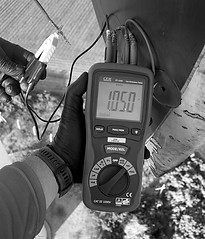
LPS Inspection

The Lightning Protection System (LPS) is one of the most critical safety components of a wind turbine, designed to safely conduct lightning energy away from the blade structure and prevent catastrophic damage. Even a minor issue in electrical continuity or an increase in resistance can compromise the effectiveness of the system, leaving the blade vulnerable to severe lightning strikes.
When the LPS does not perform as intended, lightning energy may disperse through the blade laminate, causing internal burning, delamination, structural cracking or complete blade failure. Proper LPS testing and engineering based evaluation are therefore essential to verify system integrity, ensure compliance with IEC and OEM requirements, and protect both the blade structure and overall turbine reliability.

Engineering Validation for Lightning Safety
Atlas Createch Approach to LPS Testing
At Atlas Createch, Lightning Protection System integrity is verified through a comprehensive engineering process, not just standard electrical measurements. Each test result is analyzed in relation to blade structure, lightning attachment behavior and potential damage scenarios.
Rather than treating continuity and resistance values as isolated numbers, our engineers evaluate how the LPS performs as a complete system under real operating conditions. This approach allows us to identify hidden weaknesses, assess actual risk levels and recommend corrective actions based on engineering justification.
By combining accurate measurements with expert interpretation, Atlas Createch ensures that LPS performance is fully validated, significantly reducing the risk of lightning related blade damage and enhancing long term turbine safety.
Proper LPS testing requires:
-
Accurate measurements
-
Engineering level interpretation
This significantly reduces the risk of catastrophic blade failure.
Scope:
-
Continuity Testing
-
Grounding Resistance Measurement
-
Down Conductor Analysis
-
Receptor Testing
Results are interpreted not only as numeric outputs, but through engineering evaluation and risk understanding.